Overnight White Loaf
Because the fridge does the work, and patience does the seasoning.
Definition
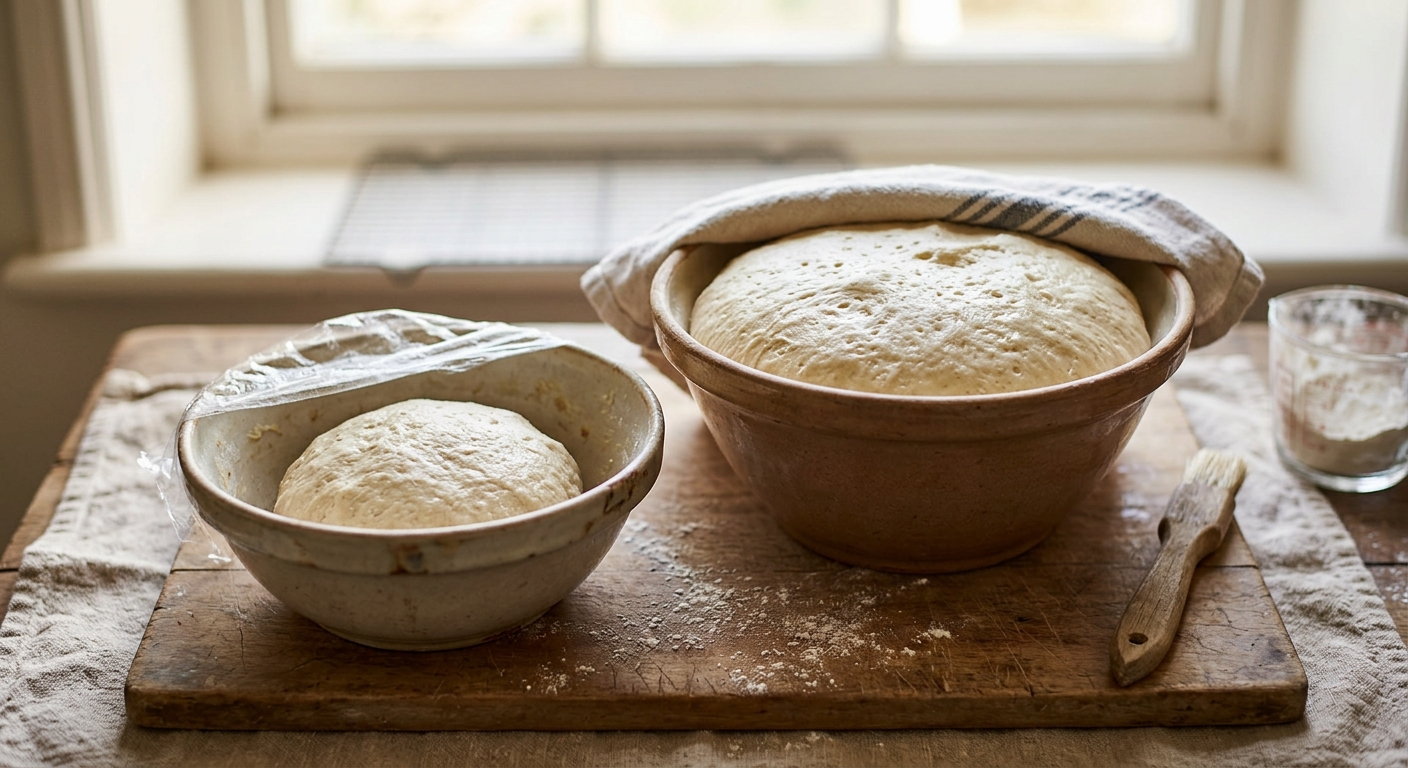
Proofing is where the flavour of bread develops. Yeast consumes sugars in the flour and produces carbon dioxide — this inflates the dough — and alcohol and other compounds that create flavour. A long, slow proof in a cool place produces more flavour than a fast proof in a warm one. Most bread has two proofs — the bulk fermentation after mixing, and the final proof after shaping. Skipping either one produces flat, flavourless bread.
Ingredients
500 g strong white bread flour, plus extra for dusting; 7 g fast-action dried yeast (1 sachet); 10 g fine salt; 5 g caster sugar; 325 ml lukewarm water; 1 tbsp olive oil, plus extra for the bowl.
Kitchen Table
A tailored kitchen-material list is being prepared for this recipe.
Method
- Combine the flour, yeast, salt, and sugar in a large bowl — keep the salt and yeast on opposite sides until you mix. Add the water and olive oil. Bring it together into a shaggy dough, then turn it out onto a clean surface and knead for 8–10 minutes until smooth, elastic, and faintly tacky. It should spring back when you poke it.
- Shape the dough into a ball and place it in a lightly oiled bowl. Cover tightly with cling film. Leave it at room temperature for 1 hour — this is the bulk fermentation, your first proof. The dough should noticeably puff. Do not skip this.
- Knock the dough back gently with your fist. Fold it over itself a few times, then shape it into a smooth oval or round to fit your tin or proving basket. Place it seam-side down in a lightly floured 900 g loaf tin or a well-floured proving basket. Cover loosely with oiled cling film.
- Transfer immediately to the fridge. Leave it overnight — or for up to 14 hours. This is the final proof. Cold slows the yeast without stopping it entirely. In that time, flavour compounds develop that a warm, rushed proof cannot produce. The dough should roughly double and look slightly domed.
- The next morning, place a heavy lidded casserole or Dutch oven in the oven and preheat to 240°C (220°C fan). This takes 30 minutes. Meanwhile, remove the dough from the fridge — do not let it come to room temperature first.
- Carefully lower the cold dough into the scorching hot pot. Score the top swiftly with a sharp knife or lame — one confident slash, slightly off-centre. Replace the lid and bake for 20 minutes. Remove the lid and bake for a further 15 minutes until deep golden and hollow-sounding when tapped underneath.
- Transfer to a wire rack immediately. Leave it for at least 30 minutes before cutting. The interior is still setting — cutting too early produces a gummy crumb. This is the final, uncelebrated step that most people ignore, and most bread suffers for it.
Critical Points — The WOW Factor
Chef's critical points and the wow-factor tagline for this recipe are being written and will appear here soon.
— Bread made in a hurry is just heated flour — time is the ingredient that has no supermarket aisle.
From the Bite & Banter Pinterest kitchen